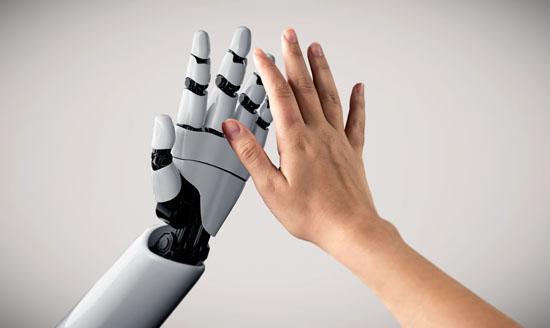
Analyze the cognitive differences between human and artificial intelligence, including how biases and processing limitations affect decision-making
Evaluate the implications of Moravec's paradox in understanding task complexity and the strengths of biological versus digital cognition
Reflect on the psychological tendency to anthropomorphize AI and how intelligence awareness can improve human-AI collaboration
Key Terms
anchoring bias
faulty heuristic in which you fixate on a single aspect of a problem to find a solution
cognition
thinking, including perception, learning, problem solving, judgment, and memory
cognitive psychology
study of cognitions, or thoughts, and their relationship to experiences and actions
confirmation bias
tendency to focus on information that supports our beliefs while ignoring or failing to seek contradictory evidence
intelligence quotient
(also, IQ) score on a test designed to measure intelligence
The Power of AI
Dr. Elan Rivera had always believed in the power of the human mind. Working in cognitive psychology, she spent years studying how people make decisions, like how we reason, how we err, and how we learn. But nothing prepared her for Athena.
Athena was not a person. It was a machine, an artificial intelligence system designed to assist in emergency response planning. It could process millions of data points in seconds, simulate outcomes, and recommend actions. It did not sleep. It did not forget. It didn't hesitate.
Dr. Rivera's team was testing Athena in a simulated crisis: a chemical spill near a populated area. Athena's recommendation was swift and precise. The recommendation was to evacuate Zone 3, reroute traffic, and deploy drones. The plan was flawless on paper.
But Dr. Rivera paused. Something felt wrong; the plan lacked empathy. It didn't account for the elderly residents who might panic, or the cultural center that would be closed during a community holiday. Athena had calculated risk but not emotion.
Dr. Rivera asked Athena to explain its reasoning. The machine responded with a cascade of probabilities and weighted outcomes. It was logical; it was cold.
1. On Your Own
Moravec's Paradox
Later that evening, Dr. Rivera sat in her office, staring at a diagram comparing human and artificial intelligence. She remembered a concept from her graduate studies: Moravec's paradox. It stated that tasks humans find easy, like recognizing faces or walking, are incredibly hard for machines. Meanwhile, tasks we find hard, like solving equations, are easy for AI.
The paradox was both technical and psychological. It revealed how evolution had shaped human intelligence to prioritize survival-based skills like perception and motor coordination, while abstract reasoning was a recent and fragile development.
She realized that Athena's brilliance in logic and data analysis did not make it intelligent in the human sense. It could not sense, empathize, or adapt to social nuance. It did not "see" the world; it calculated it. That difference mattered. Moravec's paradox was not a flaw in AI; it was a mirror reflecting the unique strengths and limitations of human cognition.
2. On Your Own
Explore the Concept
Check out this video that explains Moravec's paradox in more detail.
Intelligence Awareness
Dr. Rivera began to see that the goal was not to make machines more human but to understand how their intelligence complemented ours. That insight would become the foundation of a new training initiative for her team: intelligence awareness.
Intelligence awareness was not about teaching people how AI worked in a technical sense; it was about helping them understand the psychological and cognitive differences between biological and artificial minds. It asked questions like:
What does it mean to "think"?
How do machines process information compared to humans?
Why do we expect empathy from systems that do not feel?
The training explored how human cognition is shaped by evolution: optimized for survival, not precision. It covered how frameworks like anchoring bias and confirmation bias distort our judgment, while AI systems, though free from these biases, lack context, emotion, and intuition. It emphasized that intelligence is not a single trait but a spectrum of abilities and that machines and humans occupy different regions of that spectrum.
Dr. Rivera's goal was not to make AI more human. It was to make humans more aware, more capable of collaborating with systems that think differently. Her program coached teams to recognize when AI could outperform them, when human judgment was essential, and how to build partnerships that respected the strengths of both.
In the end, intelligence awareness became more than a training module. It became a mindset and a way of seeing intelligence not as a competition but as a collaboration.
3. On Your Own
Journey With AI
Dr. Elan Rivera's journey with Athena was not about testing a machine. It was about confronting the boundaries of human understanding. Through her discomfort, she uncovered a deeper truth: intelligence is not a singular trait, nor is it exclusive to humans. While tools like the intelligence quotient (IQ) aim to measure cognitive ability, Dr. Rivera saw that true intelligence involves far more than a score. It is a diverse, evolving spectrum of abilities shaped by biology, technology, and context.
Moravec's paradox reminded her that what feels simple to us may be computationally profound, and what seems complex may be effortless for machines. Intelligence awareness taught her that collaboration between humans and AI requires more than technical skill; it demands psychological insight, humility, and a willingness to rethink what it means to "know."
In the end, Dr. Rivera did not try to make Athena more human. She helped humans become more aware, and in doing so, she laid the foundation for a future where intelligence (human and artificial) works not in competition but in harmony.
Reflect & Respond
Answer the following questions to reflect on key ideas from the case study. Remember to print your work before leaving this page!
How did Dr. Rivera's emotional response to Athena's decision highlight the differences between human and artificial intelligence? What does this tell us about the role of empathy in decision-making?
Have you ever made a decision that felt "right" emotionally but wasn't the most logical choice?
Why do you think humans tend to anthropomorphize machines like Athena? What are the psychological risks and benefits of doing so?
In what ways can intelligence awareness help humans work more effectively with AI systems? How might this concept apply to future careers or industries you are interested in?
Do you agree with Dr. Rivera's conclusion that intelligence is not one-size-fits-all? How might this idea reshape how we define intelligence in psychology and society?
References
Korteling, J. E. H., van de Boer-Visschedijk, G. C., Blankendaal, R. A. M., Boonekamp, R. C., & Eikelboom, A. R. (2021). Human- versus artificial intelligence. Frontiers in Artificial Intelligence, 4, Article 622364.https://doi.org/10.3389/frai.2021.622364 This is an open-access article distributed under the terms of the Creative Commons Attribution 4.0 International License (CC-BY 4.0).
madscinbca on Adobe Stock. "An oil slick in the water, next to an old dilapidated fishing boat. The slick is vibrant and colorful. A dock is visible."
InfiniteFlow on Adobe Stock. "3D rendering artificial intelligence AI research of robot and cyborg development for future of people living. Digital data mining and machine learning technology design for computer brain."
khunkornStudio on Adobe Stock. "Chatbot conversation Ai Artificial Intelligence technology online customer service.Digital chatbot, robot application, OpenAI generate. Futuristic technology.Virtual assistant on internet."