Identify the components of classical conditioning (e.g., conditioned stimulus, unconditioned stimulus, conditioned response, unconditioned response) in real-life scenarios
Explain how classical conditioning can influence behavior in everyday contexts, such as food aversions or emotional responses
Apply classical conditioning principles to analyze simple case studies involving learned associations
Key Terms
classical conditioning
learning in which the stimulus or experience occurs before the behavior and then gets paired or associated with the behavior
conditioned response (CR)
response caused by the conditioned stimulus
conditioned stimulus (CS)
stimulus that elicits a response due to its being paired with an unconditioned stimulus
unconditioned response (UCR)
natural (unlearned) behavior to a given stimulus
unconditioned stimulus (UCS)
stimulus that elicits a reflexive response
A Fancy Dinner, a Lasting Reaction
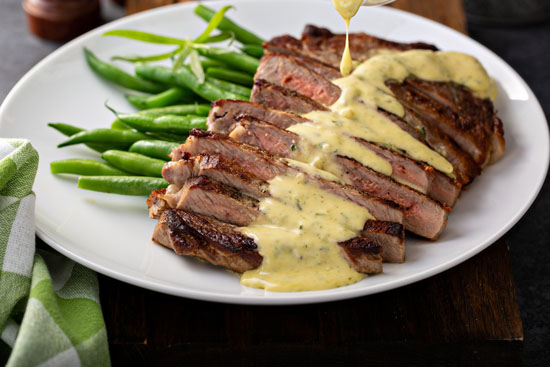
Ravi loved fine dining. One evening, he treated himself to a luxurious meal: filet mignon with béarnaise sauce and roasted vegetables. Hours later, Ravi woke up nauseous and spent the night sick. Days later, he learned it was the flu, not the food, that caused his illness.
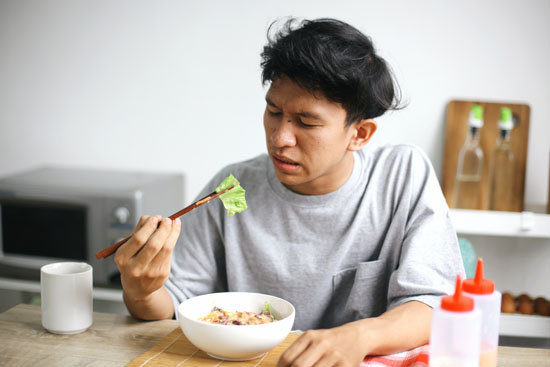
Yet something strange happened. Every time Ravi saw béarnaise sauce, he felt queasy; he couldn't even smell it without gagging. The sauce had become repulsive to him even though it wasn't the true cause of his sickness.
1. On Your Own
When Taste Turns Against You
Ravi's experience is a classic example of taste aversion, a form of classical conditioning. The béarnaise sauce (originally neutral) became a conditioned stimulus (CS). The nausea (an unconditioned response [UCR]) was caused by the flu (unconditioned stimulus [UCS]), but Ravi associated it with the sauce. Now, the sauce triggers nausea (conditioned response [CR]) even though it wasn't the true cause.
This phenomenon is known as the Garcia effect, named after psychologist John Garcia, who discovered that animals could form strong associations between taste and illness, even with long delays between the two.
2. On Your Own
Flavor Aversion
Garcia's experiments showed that rats exposed to flavored water followed by nausea (induced by radiation or chemicals) quickly developed aversions to the flavor. Interestingly, they did not develop aversions to lights or sounds paired with the same illness. This suggests that biological preparedness plays a role. Organisms are more likely to associate taste with sickness than other stimuli.
3. On Your Own
Explore the Concept
Consider this video about flavor aversion learning to learn more.
Conditioning in Everyday Life
Ravi's experience shows that classical conditioning is not limited to controlled experiments. A single pairing of béarnaise sauce and illness led to a strong aversion, even though the sauce was not the true cause. His brain linked the flavor to the nausea, creating a lasting association that now triggers discomfort. These learned responses can shape how people react to food, places, and even emotions. What begins as a neutral experience can become emotionally charged through conditioning. This process plays a role in phobias, cravings, and habits that feel automatic but are rooted in past associations. Therapists and researchers use these insights to help people reshape their reactions and build healthier patterns.
Reflect & Respond
Answer the following questions to reflect on key ideas from the case study. Remember to print your work before leaving this page!
How might classical conditioning influence your own preferences or aversions to certain foods, smells, or places?
Why do you think Ravi associated his nausea with the béarnaise sauce instead of other parts of the meal or the flu itself? What does this suggest about how we form associations?
Do you believe that classical conditioning happens consciously or unconsciously in most cases? Why?
How does the Garcia effect challenge traditional views of classical conditioning, and what does it reveal about biological preparedness?
In what ways could understanding classical conditioning help professionals in fields like education, therapy, or marketing?
References
Eelen, P. (2018). Classical conditioning: Classical yet modern. Psychologica Belgica, 58(1), 196–211.https://doi.org/10.5334/pb.451 This is an open-access article distributed under the terms of the Creative Commons Attribution 4.0 International License (CC-BY 4.0).
fahrwasser on Adobe Stock. "Steak with bearnaise sauce made with tarragon."
Gatot on Adobe Stock. "Unhappy Asian Young Man Showing Not Delicious While Holding Vegetable With Chopstick."
oneinchpunch on Adobe Stock. "Storytelling image of a multiethnic group of people dining on a rooftop. Family and friends make a reunion at home ad dining outdoor."