Bullying and the Struggle for Equal Ground


Chapter 5: Learning

Learning Outcomes

  • Analyze the psychological impact of power asymmetry in bullying situations and its influence on conflict resolution effectiveness
  • Evaluate the limitations of adaptive conflict management styles when applied in contexts of systemic aggression and victimization
  • Reflect on the role of self-attribution in shaping personal identity and psychological adjustment during unresolved peer victimization

Key Terms

latent learning
learning that occurs, but it may not be evident until there is a reason to demonstrate it
model
person who performs a behavior that serves as an example (in observational learning)
observational learning
type of learning that occurs by watching others
vicarious punishment
process where the observer sees the model punished, making the observer less likely to imitate the model's behavior
vicarious reinforcement
process where the observer sees the model rewarded, making the observer more likely to imitate the model's behavior

What Eliana Learned

Eliana had always been the kind of student teachers admired: articulate, emotionally intelligent, and deeply empathetic. She thrived in collaborative environments and often helped mediate disputes among classmates. Her approach was rooted in mutual respect and problem-solving, a style she had unconsciously adopted from her parents and refined through years of peer interaction. Her parents had served as early models, demonstrating respectful communication and empathy in everyday situations. This is an example of observational learning, where Eliana shaped her behavior by watching how others handled conflict.

But in her junior year, something shifted.

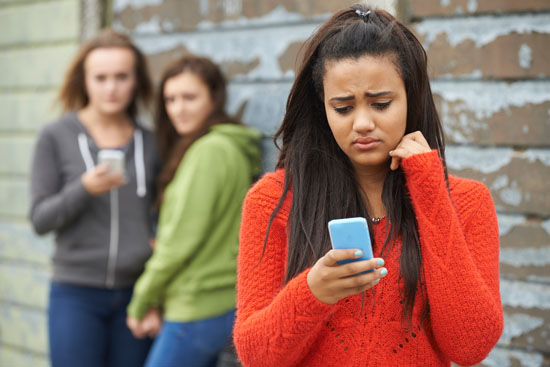
A young person frowning at their phone while two other teenagers look at them from behind

A group of students began targeting her. It started with subtle exclusion, like being left out of group chats, whispered jokes, and eye rolls during presentations. Then came the escalation: anonymous messages, rumors spread online, and deliberate sabotage of her schoolwork. Eliana, confused and hurt, responded with the tools she knew best. She tried to integrate by talking openly and seeking understanding. She compromised, avoided confrontation, even obliged their requests, hoping to de-escalate the tension.

None of it worked. The more she tried to resolve the situation, the more isolated she became. Her sense of control eroded. She began skipping school, her grades slipped, and she withdrew from student council. Her internal narrative shifted from "I can fix this" to "Maybe I deserve this."

It wasn't until a meeting with her counselor, Ms. Reyes, that Eliana began to see the situation differently.

1. On Your Own

Which psychological factor most contributed to Eliana's inability to resolve the bullying through conflict management? Select the best answer.

Power Asymmetry

Eliana's counselor, Ms. Reyes, helped her unpack a critical insight. The reason her conflict resolution strategies failed wasn't because she lacked skill; it was because she was operating in a context of power asymmetry.

In typical peer conflicts, both parties have relatively equal standing. They may disagree, but each has the ability to assert their needs, negotiate, and reach compromise. Eliana had mastered these dynamics. But bullying is not a conflict between equals. It is a structural imbalance, where one party, the perpetrator, holds disproportionate control over the other.

In Eliana's case, the group targeting her had social dominance. They were popular, well-connected, and skilled at manipulating group dynamics. They didn't want resolution; they wanted control. Every time Eliana tried to integrate or compromise, she unknowingly reinforced their power. Her willingness to cooperate was interpreted as submission rather than strength. Other students who witnessed Eliana being ridiculed experienced vicarious punishment, learning that standing up to the dominant group could result in social exclusion.

An image of a scale, with one person on the lower end and multiple people on the higher end

Ms. Reyes explained that power asymmetry in bullying is not just about physical strength or numbers; it's about access, influence, and intent. The aggressors could spread rumors, isolate Eliana socially, and undermine her reputation with ease. Eliana, on the other hand, had no comparable tools. Her emotional intelligence and conflict skills were rendered ineffective because the aggressors had no interest in mutual understanding.

This imbalance meant that Eliana's usual strategies, such as integrating, compromising, and avoiding, were structurally blocked. She couldn't escape the situation because she had to attend school. She couldn't dominate because retaliation was likely. And she couldn't integrate because the other side refused to engage.

2. On Your Own

Determine whether the following statement is true or false.

Conflict resolution strategies like integrating and compromising require cooperation from both parties to be effective.

The Effect of Bullying

As the bullying escalated, Eliana began to internalize the failure of her conflict resolution efforts. She had always believed that empathy, listening, and compromise could solve any interpersonal issue. But now, every attempt to de-escalate was met with ridicule or silence. Her strategies, which were once praised by teachers and peers, seemed powerless. This disconnect triggered a profound sense of personal inadequacy.

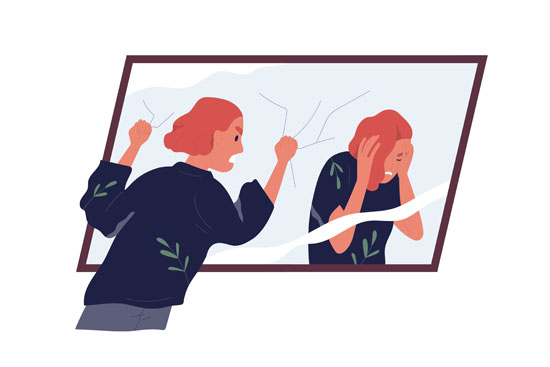
Her self-talk shifted from confident to self-critical. The bullying wasn't just hurting her socially; it was reshaping her identity. Psychologically, this is a common response in victims of power-imbalanced aggression. When resolution fails, especially after repeated efforts, the victim often assumes the failure is internal. This is known as self-attribution bias: the tendency to blame oneself for negative outcomes, even when external forces are responsible.

An image of a person yelling at themselves in the mirror, while the reflection hides in shame

Eliana's sense of control diminished. She stopped speaking up in class, withdrew from leadership roles, and avoided social situations. Her academic performance declined, not because she lacked ability but because she no longer believed in her ability. The bullying had created a feedback loop: failed resolution led to self-blame, which led to withdrawal, which made her more vulnerable.

Ms. Reyes recognized these signs and helped Eliana reframe her experience. She explained that Eliana's conflict management skills weren't inadequate; they were simply misapplied to a situation that wasn't a conflict. It was targeted aggression, and no amount of empathy could resolve it without structural support.

3. On Your Own

Which of the following are true in Eliana's case? Select the three that apply.

Disrupted Power Dynamics

Ms. Reyes then coordinated with Eliana's teachers to monitor classroom dynamics and ensure accountability. She facilitated a meeting with school leadership to address the behavior of the aggressors, not through mediation, but through structured disciplinary action. Eliana was not asked to reconcile with her bullies or "see their side." Instead, the school made it clear that the behavior was unacceptable and would not be tolerated.

In parallel, Ms. Reyes helped Eliana rebuild her psychological resilience. They worked on reframing her internal narrative from "I failed to fix this" to "I was placed in an impossible situation." Through journaling, cognitive restructuring, and peer support groups, Eliana began to reclaim her voice. She rejoined student council, started mentoring younger students, and even led a school-wide campaign on recognizing bullying versus conflict. When Eliana was publicly praised for her advocacy, younger students experienced vicarious reinforcement, which made them more likely to speak out against bullying themselves. Eliana's leadership in the campaign reflected latent learning, as she had internalized lessons about advocacy and resilience long before she had the chance to act on them.

The intervention didn't just stop the bullying; it restored Eliana's sense of agency. It reminded her that healing isn't about being strong enough to endure harm; it's about being supported enough to rise above it.

A picture of several hands joining in a joint high-five

Explore the Concept

Interact with this video about anti-bullying strategies.

Conflict vs. Bullying

Eliana's journey illustrates a critical psychological truth: Not all interpersonal problems are conflicts. When power and intent to harm are present, resolution requires more than empathy. It requires intervention.

For psychology students, her case is a reminder to look beyond behavior and examine structure, intent, and context. Understanding these distinctions is essential for designing effective support systems in schools and beyond.

Reflect & Respond

Answer the following questions to reflect on key ideas from the case study. Remember to print your work before leaving this page!

  1. How did Eliana's perception of her own abilities change as the bullying progressed, and what psychological mechanisms might explain this shift?
  2. In what ways did power asymmetry limit Eliana's ability to apply conflict resolution strategies, and how might this inform how we support victims in similar situations?
  3. What role did self-attribution play in Eliana's psychological adjustment, and how can reframing help victims recover a sense of agency?
  4. Why is it important to distinguish between conflict and bullying in educational settings, and what are the risks of conflating the two?
  5. Reflect on a time when you or someone you know faced a situation where resolution wasn't possible. What factors contributed to that, and how was the situation ultimately addressed?

References

Burger, C. (2022). School bullying is not a conflict: The interplay between conflict management styles, bullying victimization and psychological school adjustment. International Journal of Environmental Research and Public Health, 19(18), Article 11809. https://doi.org/10.3390/ijerph191811809
This is an open-access article distributed under the terms of the Creative Commons Attribution 4.0 International License (CC-BY 4.0).

SciShow Psych. (2019, September 30). Can these psychology strategies prevent bullying? [Video]. YouTube. https://youtu.be/Yie1dWzmgvw?si=2ExMjkOFgBQgMnKg

Photo Credits

highwaystarz on Adobe Stock. "Teenage Girl Being Bullied By Text Message."

Destina on Adobe Stock. "Business balance."

Good Studio on Adobe Stock. "Concept of self-judgment, criticism, and mental problems. Inner critic blaming, shaming, and shouting at mirror reflection. Woman feeling guilty. Colored flat vector illustration isolated on white."

Rawpixel.com on Adobe Stock. "Diverse group of hands, teamwork, unity. Hands of different ethnicities, collaboration, support. Teamwork, unity, diverse hands reaching together. Diverse hands from people teamwork image."