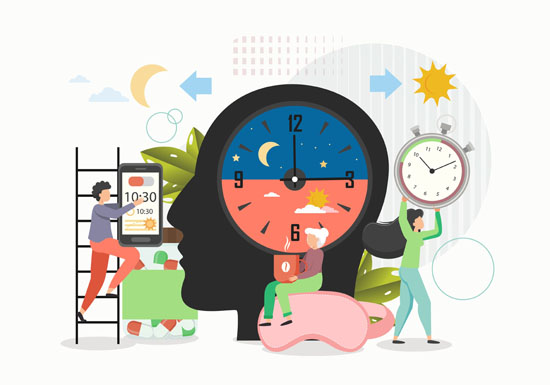
Identify how biological rhythms and circadian rhythms influence individual sleep patterns and daily functioning
Analyze the relationship between chronotype, academic performance, and sleep debt in college students
Apply strategies to align personal schedules with natural sleep-wake cycles, including the role of melatonin and sleep hygiene
Key Terms
biological rhythm
internal cycle of biological activity
circadian rhythm
biological rhythm that occurs over approximately 24 hours
melatonin
hormone secreted by the endocrine gland that serves as an important regulator of the sleep-wake cycle
sleep debt
result of insufficient sleep on a chronic basis
Rhythms and Energy
Casey and Jordan are college roommates with very different sleep habits. Casey thrives at night, often studying until 2 a.m. and sleeping through early classes. Jordan, on the other hand, wakes up naturally at 6 a.m. and prefers morning lectures. Their different sleep preferences are shaped by their circadian rhythms, which regulate cycles of alertness and fatigue over a 24-hour period. As the semester progresses, they both notice differences in their academic performance and energy levels. Curious, they begin to wonder: Could their internal clocks be influencing their success?
1. On Your Own
The Effects of Sleep Debt
Jordan finds a recent study that explores how students' chronotypes (whether they identify as "early birds" or "night owls") can impact academic performance. The study suggests that students who align their class schedules with their natural biological rhythms tend to perform better and experience less sleep debt. Melatonin, a hormone that helps regulate the sleep-wake cycle, is released in response to darkness and may influence when students feel naturally ready to sleep or wake. Casey realizes that staying up late and missing morning classes might be hurting their focus and memory.
Explore the Concept
Check out this video with more information about "early birds" vs. "night owls."
2. On Your Own
What Is Your Chronotype?
Have you ever wondered if you're more of a morning person or a night owl? Take this short quiz to discover your chronotype and learn how your internal clock might be influencing your energy, focus, and academic performance.
Putting It Into Practice
Motivated by the findings, Casey begins shifting their schedule to better match their natural rhythm by taking later classes and improving sleep hygiene. Jordan, meanwhile, continues to benefit from early classes and consistent sleep. Both roommates learn that understanding their biological rhythms can help them make smarter academic and lifestyle choices.
Reflect & Respond
Answer the following questions to reflect on key ideas from the case study. Remember to print your work before leaving this page!
Do you feel more alert in the morning or at night?
How do your sleep patterns affect how you feel, how well you focus, or how you do in class?
What are some realistic changes you could make to your daily routine to better match your natural rhythm and feel more energized?
How might understanding your own chronotype help you make more effective decisions about your daily schedule, academic workload, and sleep habits?
What challenges might arise when your natural sleep-wake cycle conflicts with societal or academic expectations, and how could you adapt while still prioritizing your well-being?
Yalçin, M., Mundorf, A., Thiel, F., Amatriain-Fernández, S., Kalthoff, I. S., Beucke, J.-C., Budde, H., Garthus-Niegel, S., Peterburs, J., & Relógio, A. (2022). It's about time: The circadian network as time-keeper for cognitive functioning, locomotor activity and mental health. Frontiers in Physiology, 13, Article 873237.https://doi.org/10.1097/MD.0000000000034776 This is an open-access article distributed under the terms of the Creative Commons Attribution 4.0 International License (CC-BY 4.0).
Photo Credits
skypicsstudio on Adobe Stock. "Biorhythms. Day and night activity, flat vector illustration. Rhythmic biological cycles, human chronotypes."
Dragonimages on Adobe Stock. "Smiling Teenage Roommates."
Delcio/peopleimages.com on Adobe Stock. "Student, writing and hand with notebook for studying, learning and creative notes for academic class. University, college and zoom of hands with pen to write schedule information, planning and ideas."