What the Research Says
Concussions, even when classified as mild traumatic brain injuries (mTBIs), can disrupt the brain networks involved in attention, emotional regulation, memory, and decision-making. These disruptions are often linked to temporary or prolonged changes in the frontal lobe, amygdala, and hippocampus. These regions play key roles in behavior, mood, and cognitive control.
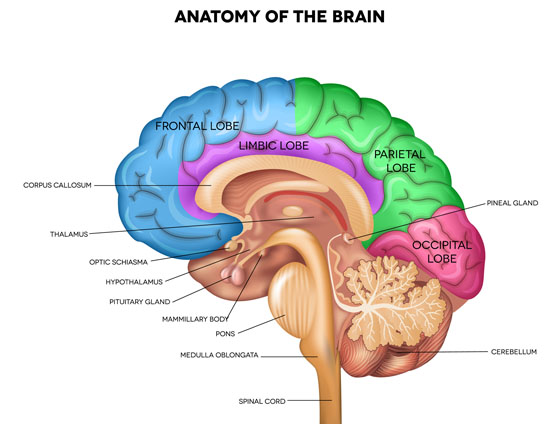
A detailed anatomical illustration of the human brain, segmented into color-coded regions to distinguish various lobes and internal structures. The Frontal Lobe is shaded in blue, the Limbic Lobe in purple, the Parietal Lobe in green, the Occipital Lobe in pink, and the Cerebellum in brown. Fine lines extend from each labeled part to its corresponding location within the brain. Labeled structures include the Corpus Callosum, Thalamus, Optic Chiasma, Hypothalamus, Pituitary Gland, Mammillary Body, Pons, Medulla Oblongata, Spinal Cord, and Pineal Gland.
Research shows that individuals may experience symptoms such as irritability, impulsivity, anxiety, and difficulty concentrating. These behavioral changes can emerge days or even weeks after the injury and may fluctuate over time. In some cases, individuals also report changes in sleep patterns, increased sensitivity to noise or light, and difficulty managing stress.
While many people recover fully with rest and support, the brain's healing process varies. Neuroplasticity allows the brain to adapt and rewire, especially when recovery strategies are introduced early. However, repeated concussions or delayed treatment can increase the risk of persistent symptoms and long-term cognitive or emotional challenges.
Understanding these effects is essential for recognizing that concussions are not just physical injuries; they can also impact how a person thinks, feels, and behaves.