Gendered Pathways to Success


Chapter 10: Gender, Sex, and Sexuality

Learning Outcomes

  • Analyze how gender stereotypes influence expressions of psychological resilience and academic behavior
  • Compare different resilience styles and evaluate their impact on academic performance
  • Reflect on personal academic strategies and consider how identity and social norms affect learning behaviors

Key Terms

double standard
a rule or principle that is unfairly applied in different ways to different people
gender
a social construction based on a person's identity, presentation of self, behavior, and interaction with others
gender stereotypes
overgeneralizations surrounding the attitudes, traits, or behavior patterns of certain genders

Two Different Journeys

Meet Bruno and Hila, two first-year university students navigating the challenges of college life. Both are bright, motivated, and determined to succeed, but they approach their academic journey in very different ways. Their differences reflect how gender, as a social construction, can shape behavior, self-expression, and academic strategies.

Hila, a health sciences major, keeps a detailed planner, attends study groups, and often leans on her family and friends for emotional support. She believes that hard work and planning are key to success. Her grades reflect her effort; she’s consistently among the top of her class.

Bruno, an engineering student, prefers to work alone. He is confident in his abilities and rarely asks for help. He believes that intelligence should be enough to succeed and worries that seeking support might make him appear weak. His grades are average, and he often feels disconnected from the academic environment.

A person with their head in their hands surrounded by books on a desk

One afternoon, after a particularly tough exam, Hila and Bruno sat together in the campus café. Hila vented about how overwhelmed she felt but also how her study group had helped her prepare. Bruno shrugged. “I just winged it,” he said. “If I try too hard, it feels like I’m not smart enough.”

Hila paused. “But isn’t trying the point?”

Bruno did not answer.

1. On Your Own

Which of the following is most likely a consequence of gender stereotypes in academic settings? Select the two that apply.

Rational Resilience

As the semester progressed, Hila's grades remained strong. Her resilience, expressed through planning and social support, helped her adapt and thrive. Bruno, meanwhile, struggled. His resilience looked different: pride in his achievements, belief in his strength. But it did not translate into academic success.

Hila's behavior aligns with research showing that women often display and benefit academically from relational resilience, a form of psychological resilience rooted in social support and planning. Studies suggest that these traits are linked to better academic outcomes for female students.

A person holding their books and smiling at the camera

Men, on the other hand, showed no clear link between their resilience traits and academic performance. Bruno's approach, while confident, may reflect what researchers call pseudoresilience, which is a socially constructed form of resilience where men feel pressured to appear strong and self-reliant, even when struggling.

2. On Your Own

Which psychological concept explains Hila's tendency to seek support and plan her academic tasks? Select the best answer.

Bruno's Improvements

One evening, after receiving another disappointing grade, Bruno opened up to Hila. "I don't know how you do it," he said. "You ask for help; you plan everything. I feel like I am supposed to just know how to do it all." Bruno's comment reflects a double standard, where effort and seeking help are often seen as acceptable for women but as signs of weakness for men.

Hila smiled gently. "I used to think that too, but I realized that being strong doesn't mean doing it alone."

That moment marked a shift. Bruno realized it was not a weakness to ask for help and accept it. He started joining study groups, asking questions, and even calling his older sister for advice. His grades improved, not dramatically but enough to feel proud. More importantly, he felt less alone. He still valued independence, but now he understood that resilience could also mean knowing when to lean in, not just when to stand alone.

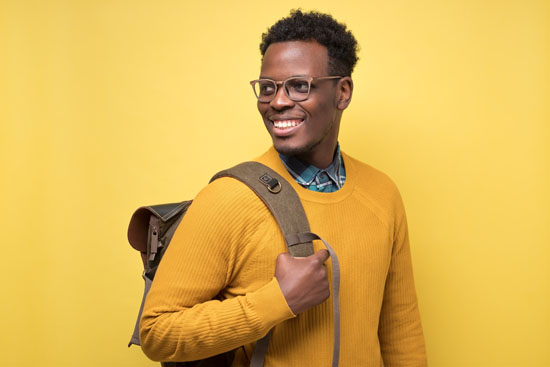
A student with a backpack, smiling and looking past their shoulder

3. On Your Own

Determine whether the following statement is true or false.

In academic settings, resilience that includes social support and planning is more likely to lead to success.

Explore the Concept

Check out this video to learn more about stereotypes and their harmful effects on others.

Results of Resilience

Hila and Bruno took different paths through their first year of college: one guided by connection and planning, the other by independence and quiet determination. Yet both showed resilience in their own ways. Hila's success was rooted in the support she embraced and the structure she built around her goals. Bruno's journey was more internal, shaped by a slow realization that strength does not mean going at it alone.

Their stories reflect a deeper truth: Resilience is not a fixed trait, but a flexible response shaped by identity, experience, and social expectations. For Hila, resilience meant leaning in. For Bruno, it meant letting go of the idea that asking for help was weakness.

Together, they show that academic success is not just about intelligence or effort; it is about how we navigate the pressures of who we think we are supposed to be. And when students are free to define resilience on their own terms, they do not just perform better; they grow stronger, together.

Reflect & Respond

Answer the following questions to reflect on key ideas from the case study. Remember to print your work before leaving this page!

  1. How do gender expectations influence the way students approach academic challenges? Reflect on how societal norms may shape your own study habits or willingness to seek help.
  2. In what ways did Hila and Bruno demonstrate resilience differently?
  3. Have you ever felt pressure to conform to a certain identity (e.g., being independent, always prepared, never asking for help)? How did that affect your academic performance or emotional well-being?
  4. What does "strength" mean to you in the context of learning and personal growth? Has your definition changed over time?
  5. If you were to redesign your approach to studying based on what you learned from Bruno and Hila, what would you change or keep the same?

References

Gil, S. V. (2024). The influence of gender on academic performance and psychological resilience, and the relationship between both: Understanding the differences through gender stereotypes. Trends in Psychology. https://doi.org/10.1007/s43076-024-00370-7
This is an open-access article distributed under the terms of the Creative Commons Attribution 4.0 International License (CC-BY 4.0).

TED-Ed. (2021, December 2). Can stereotypes ever be good? - Sheila Marie Orfano and Densho [Video]. YouTube. https://youtu.be/aFXmyNUaXFo?si=9f7gx3G-6vhunvz0

Photo Credits

Олег Кононов on Adobe Stock. "young male student sits at a desk with books on the background of a black wall. he took his face with his hands. Difficulties in telecommuting and learning in quarantine."

unai on Adobe Stock. "Portrait of a chinese university student in the campus."

Viktor Koldunov on Adobe Stock. "Happy african american college student holding backpack and smiling being glad to study. Studio shot on yellow wall."